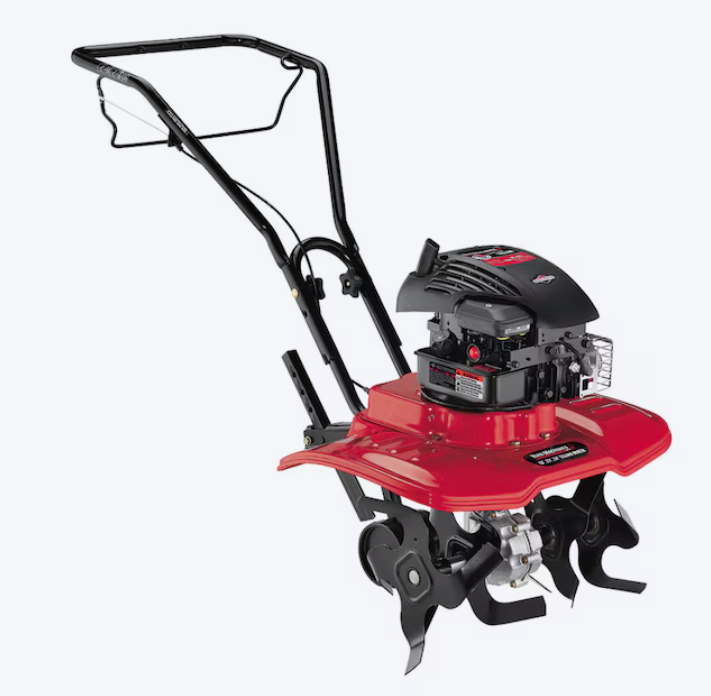
Yard Machines 24″ 5 Ft/Lbs Tiller
- Adjustable tilling widths give you multiple options for use
- Front tine design allows for closer tilling next to obstacles and smaller areas
- Forward rotating tines are best for established gardens or well-aereated soil
- Great for weeding inbetween garden rows during the growing season
From Garden Dreams to Reality – Your Ultimate Companion for Soil Cultivation
There’s something almost magical about the moment when you first break ground for a new garden. The smell of fresh earth, the promise of future harvests, and that satisfying feeling of transforming raw soil into a canvas for growing life. But anyone who’s ever tried to tackle compacted, stubborn soil with just a spade knows that garden dreams can quickly turn into backbreaking reality. This is where the right tiller becomes not just a tool, but a true gardening companion.
Enter the Yard Machines tiller – a name that has become synonymous with reliable, affordable soil cultivation for homeowners across America. Whether you’re a weekend warrior looking to expand your vegetable patch or a serious gardener preparing extensive planting beds, understanding what makes these tillers tick can be the difference between a season of frustration and a year of gardening success.
The Yard Machines Legacy: Built for Real Gardens, Real People
The story of Yard Machines tillers isn’t one of flashy marketing or premium positioning. Instead, it’s a tale of practical engineering designed to meet the needs of everyday gardeners who want dependable performance without breaking the bank. These tillers have earned their reputation in suburban backyards and rural homesteads alike, where the rubber meets the road – or in this case, where the tines meet the soil.
What sets Yard Machines tillers apart in today’s crowded marketplace isn’t just their competitive pricing, but their thoughtful approach to design. Every component, from the engine selection to the tine configuration, reflects a deep understanding of what home gardeners actually need rather than what they might want in theory.
Understanding Your Options: Types of Yard Machines Tillers
The beauty of the Yard Machines lineup lies in its diversity. Rather than offering a one-size-fits-all solution, the brand provides several distinct categories of tillers, each engineered for specific gardening scenarios.
Front-tine tillers represent the entry point into the Yard Machines family. These compact workhorses feature tines mounted at the front of the unit, pulling the machine forward as they dig. The design creates a natural self-propelling action that many gardeners find intuitive to control. Front-tine models excel in smaller gardens and established beds where the soil has been worked before. They’re particularly effective for mixing in amendments like compost or fertilizer, and their lighter weight makes them easier to maneuver around existing plants and garden structures.
Rear-tine tillers occupy the premium end of the Yard Machines spectrum, designed for more demanding applications. With tines positioned behind the engine and wheels, these units provide greater stability and digging power. The rear-tine configuration allows for deeper penetration and more aggressive soil breaking, making them ideal for breaking new ground or tackling heavily compacted soil. The separation between the drive wheels and the tines means you can control forward motion independently of the tilling action, resulting in more precise cultivation.
Mid-tine tillers bridge the gap between front and rear-tine models, offering a compromise of power and maneuverability that appeals to many gardeners. These units position the tines beneath the engine, creating a balanced design that’s easier to handle than rear-tine models while providing more power than front-tine alternatives.
Each configuration brings its own advantages to the garden, and understanding these differences is crucial for selecting the right tool for your specific needs.
Technical Specifications That Matter
When evaluating any Yard Machines tiller, certain technical specifications directly impact your gardening experience. The tilling width determines how much ground you can cover in each pass, with options typically ranging from 11 inches for compact models up to 24 inches for larger units. This measurement isn’t just about efficiency – it also affects maneuverability in tight spaces and around established plantings.
Tilling depth represents another critical specification, determining how deeply the unit can work the soil. Most Yard Machines tillers offer adjustable depth settings, allowing you to customize the cultivation based on your specific needs. Shallow tilling works well for weed control and amendment mixing, while deeper cultivation is essential for breaking hardpan and preparing new beds.
The engine specifications deserve particular attention, as they directly influence both performance and maintenance requirements. Yard Machines typically equips their tillers with reliable overhead valve engines ranging from 140cc to 420cc displacement. These engines are designed for the stop-and-go nature of tilling work, with torque curves optimized for low-end pulling power rather than high-speed operation.
Engine Performance and Fuel Requirements
The heart of any Yard Machines tiller beats with the rhythm of a well-engineered small engine. Most models feature four-stroke overhead valve engines that balance power with fuel efficiency. These engines typically run on regular unleaded gasoline with no mixing required, simplifying operation and maintenance compared to two-stroke alternatives.
Fuel tank capacity varies by model, but most Yard Machines tillers feature tanks sized for extended operation without frequent refueling. The fuel system includes a primer bulb for easy starting, even after extended storage periods. Many models also incorporate a fuel shut-off valve, which helps prevent fuel system problems during long-term storage.
Starting systems vary across the lineup, from traditional recoil starters on entry-level models to electric start systems on premium units. The recoil systems are engineered for easy operation, with compression release mechanisms that reduce the effort required for starting.
Forward and Reverse: The Power of Control
One of the most appreciated features across the Yard Machines tiller lineup is the inclusion of both forward and reverse gear options on many models. This functionality transforms the tilling experience from a constant pushing match to a controlled cultivation process.
Forward gear selection typically offers multiple speed options, allowing you to match the machine’s pace to soil conditions and your comfort level. Slower speeds provide maximum digging power for tough soil, while faster speeds increase productivity in prepared ground.
The reverse capability proves invaluable when you need to back out of tight spots or retreat from obstacles. Rather than manhandling a heavy tiller around, you can simply engage reverse and let the machine do the work. This feature is particularly valuable when working around existing garden beds or landscape features.
The transmission systems in Yard Machines tillers are designed for durability and ease of operation. Most models feature simple gear selection mechanisms that can be operated without tools, allowing you to adjust on the fly as conditions change.
Breaking New Ground: Power Meets Precision
For many gardeners, the ultimate test of any tiller comes when faced with virgin soil – that untouched patch of lawn or field that holds so much promise but presents such a daunting challenge. This is where the engineering philosophy behind Yard Machines tillers truly shines.
Breaking new ground requires a combination of power, persistence, and technique. The tines must be aggressive enough to bite through established root systems and break up compacted soil, while the engine must provide consistent torque even under heavy load. Yard Machines tillers approach this challenge with tine designs that balance aggression with durability.
The tine configuration varies by model, but most feature heat-treated steel construction with curved profiles that efficiently cut through soil while pulling the machine forward. The spacing between tines is optimized to prevent clogging while ensuring complete soil pulverization.
When tackling new ground with a Yard Machines tiller, technique becomes as important as equipment. The most effective approach involves multiple passes at gradually increasing depths, allowing the tines to progressively break down soil structure rather than attempting to reach full depth immediately.
Operating Your Yard Machines Tiller: Technique and Safety
Successful tilling with any Yard Machines tiller begins long before you pull the starter cord. Pre-operation inspection ensures that your tiller is ready for the demands ahead. Check engine oil level, fuel supply, and air filter condition. Inspect the tines for damage or excessive wear, and verify that all guards and safety equipment are properly installed.
Starting procedures vary by model, but most Yard Machines tillers follow a similar sequence. Ensure the fuel valve is open, engage the choke if starting cold, and activate the primer bulb several times to deliver fuel to the carburetor. With the tines clear of the ground, pull the starter cord with a smooth, firm motion.
Once running, allow the engine to warm up before engaging the tines. This brief warm-up period ensures optimal performance and extends engine life. When ready to begin tilling, gradually lower the depth stake to bring the tines into contact with the soil.
Proper tilling technique involves maintaining steady forward progress while allowing the tines to do their work. Avoid forcing the machine – let the tine design and engine power handle the soil breaking. If the tiller begins to hop or bounce excessively, reduce the depth setting or slow your forward speed.
Handling Compacted Soil: Strategy and Persistence
Compacted soil presents one of the greatest challenges in gardening, and it’s here that the robust construction of Yard Machines tillers proves its worth. Soil compaction occurs when repeated traffic, heavy equipment, or natural settling compresses soil particles together, reducing pore space and creating an almost impenetrable barrier to root growth and water infiltration.
When faced with severely compacted soil, even the most powerful Yard Machines tiller requires a strategic approach. The key lies in understanding that compaction typically occurs in layers, and successful cultivation requires systematically breaking down these layers rather than attempting to power through them all at once.
Begin with the depth setting at its shallowest position, making several passes over the area to break up the surface crust. This initial cultivation creates fractures that allow subsequent passes to penetrate deeper. Gradually increase the depth setting with each round of passes, always moving at a pace that allows the tines to maintain good soil contact without overwhelming the engine.
Tilling Width and Garden Planning
The tilling width of your Yard Machines tiller directly impacts both efficiency and garden planning. Narrow tillers excel in established gardens where precision is paramount, allowing you to cultivate between rows without damaging existing plants. Wider tillers maximize productivity in open areas but require more space to maneuver effectively.
Most Yard Machines tillers offer tilling widths that align with standard garden spacing conventions. This thoughtful engineering means you can plan your garden layout to take advantage of your tiller’s capabilities, creating pathways and spacing that accommodate efficient cultivation throughout the growing season.
The relationship between tilling width and depth capability isn’t always linear. Wider tillers often feature more powerful engines and robust transmission systems, enabling them to maintain their full width even in challenging soil conditions. Narrower models may require reduced depth settings in tough soil to maintain effective operation.
Maintenance: The Key to Long-Term Performance
Like any mechanical device, a Yard Machines tiller performs best when properly maintained. The maintenance schedule begins with regular engine service, following the manufacturer’s recommendations for oil changes, air filter replacement, and spark plug service.
Engine oil should be checked before each use and changed according to the recommended schedule. Most Yard Machines tillers use standard SAE 30 or 10W-30 oil, with capacity ranging from 16 to 20 ounces depending on engine size. Clean oil ensures proper lubrication and heat dissipation, critical factors in the demanding environment of tilling operations.
Air filter maintenance proves particularly important in tilling applications, where dust and debris are constant companions. Paper air filters should be replaced when dirty, while foam elements can often be cleaned and reused. A clean air filter ensures proper engine breathing and prevents premature wear.
Tine maintenance involves regular inspection for damage, wear, and proper attachment. Worn tines reduce tilling effectiveness and place additional stress on the engine and transmission. Most Yard Machines tillers use replaceable tines that can be easily removed with standard tools.
Troubleshooting Common Issues
Even well-maintained Yard Machines tillers occasionally develop issues that can interrupt your gardening schedule. Understanding common problems and their solutions can get you back to work quickly while avoiding unnecessary service calls.
Starting problems represent the most common complaint with any small engine equipment. If your Yard Machines tiller won’t start, begin with the basics: ensure adequate fuel supply, check for spark at the plug, and verify that the air filter isn’t completely clogged. Stale fuel is a frequent culprit, particularly if the tiller has been stored for extended periods without fuel stabilizer.
Poor tilling performance often traces to worn or damaged tines, incorrect depth settings, or operating technique. If the tiller seems to lack power, check the engine oil level and air filter condition. Excessive vibration may indicate loose bolts, worn tines, or debris wrapped around the tine shaft.
Transmission problems typically manifest as difficulty engaging gears or loss of forward motion. These issues often result from cable adjustment problems or low gear oil levels. Most Yard Machines tillers feature accessible adjustment points that allow you to fine-tune cable tension without special tools.
Cost Considerations and Value Proposition
One of the most compelling aspects of choosing a Yard Machines tiller lies in its value proposition. These tillers consistently deliver professional-grade performance at prices that remain accessible to homeowners with modest budgets.
Entry-level Yard Machines tillers typically retail for significantly less than comparable models from premium brands, yet they incorporate many of the same design principles and component quality. This cost advantage extends beyond the initial purchase, as parts availability and service simplicity keep long-term ownership costs reasonable.
Mid-range models bridge the gap between basic functionality and professional capability, offering features like electric start, multiple speed options, and enhanced tine configurations at prices that remain competitive with other manufacturers’ entry-level offerings.
Premium Yard Machines tillers compete directly with professional-grade equipment from established brands while maintaining significant cost advantages. These units incorporate heavy-duty transmissions, powerful engines, and commercial-grade tines at prices that make them accessible to serious home gardeners.
Where to Purchase Your Yard Machines Tiller
The availability of Yard Machines tillers through multiple retail channels provides flexibility in both shopping and service. Major home improvement retailers typically stock popular models year-round, with expanded selections available during peak gardening seasons.
Online retailers offer the broadest selection and often the most competitive pricing, though shipping costs for these heavy items can impact the total cost. Many online retailers offer assembly services or local delivery options that can simplify the purchasing process.
Local dealers often provide the most comprehensive service and support, with knowledgeable staff who understand local soil conditions and gardening challenges. These dealers typically offer assembly, pre-delivery inspection, and ongoing service support that can prove invaluable throughout the tiller’s life.
Comparing Front-Tine and Rear-Tine Models
The choice between front-tine and rear-tine Yard Machines tillers depends largely on your specific gardening needs and physical capabilities. Front-tine models excel in established gardens where the soil has been previously worked. Their lighter weight and more compact design make them easier to maneuver in tight spaces and around existing plants.
The self-propelling nature of front-tine tillers can be both an advantage and a challenge. In loose soil, the pulling action creates efficient forward motion that reduces operator fatigue. However, in heavy or rocky soil, this same characteristic can make the tiller difficult to control, requiring more operator strength to maintain proper direction and speed.
Rear-tine Yard Machines tillers provide greater digging power and improved control, making them better suited for breaking new ground and working in challenging soil conditions. The independent control of forward motion and tilling action allows for more precise operation, particularly when working around obstacles or maintaining specific row spacing.
The additional weight of rear-tine models provides better ground contact and reduced bouncing in hard soil, but this same weight can make transportation and storage more challenging. Consider your storage options and the distance you’ll need to move the tiller when making your selection.
Garden Size and Tiller Selection
Matching your Yard Machines tiller to your garden size ensures optimal productivity without over-investing in unnecessary capability. Small gardens under 1,000 square feet typically benefit from compact front-tine models that offer adequate power while remaining easy to store and maneuver.
Medium-sized gardens between 1,000 and 5,000 square feet represent the sweet spot for mid-range Yard Machines tillers. These gardens provide enough open space to take advantage of wider tilling widths while still requiring the precision that these tillers deliver.
Large gardens exceeding 5,000 square feet call for the power and productivity of rear-tine models. These installations justify the additional investment in premium features while providing the efficiency needed to maintain extensive planting areas without excessive time commitment.
Depth Capabilities and Soil Preparation
The depth capability of your Yard Machines tiller directly impacts the quality of soil preparation you can achieve. Most models offer adjustable depth settings ranging from surface cultivation to deep breaking of 8-10 inches.
Shallow tilling depths of 2-4 inches prove ideal for weed control, amendment incorporation, and seedbed preparation. This depth range allows you to work the active soil zone without disturbing beneficial soil organisms or bringing weed seeds to the surface.
Medium depths of 4-6 inches work well for most garden preparation tasks, providing adequate soil loosening for root development while maintaining manageable soil turnover. This depth range represents the most commonly used setting for routine garden maintenance.
Deep tilling of 6-10 inches becomes necessary when breaking new ground, addressing compaction, or incorporating deep amendments. Yard Machines tillers with this capability feature more powerful engines and robust tine systems designed to handle the increased loads associated with deep cultivation.
Customer Reviews and Real-World Performance
The true measure of any Yard Machines tiller lies not in specifications or marketing claims, but in the experiences of gardeners who depend on these machines season after season. Customer reviews consistently highlight several key themes that speak to the brand’s core strengths.
Reliability emerges as the most frequently mentioned positive attribute. Gardeners appreciate machines that start consistently, run smoothly throughout the season, and require minimal unscheduled maintenance. This reliability proves particularly important for weekend gardeners who have limited time for equipment troubleshooting.
Value represents another consistent theme in customer feedback. Users regularly comment on the surprising capability of these modestly priced machines, often comparing their performance favorably to more expensive alternatives. This value perception extends beyond initial cost to include parts availability and service accessibility.
Ease of operation receives frequent praise, particularly from gardeners who may not consider themselves mechanically inclined. The straightforward controls and intuitive operation of most Yard Machines tillers make them accessible to gardeners of all experience levels.
Comparative Analysis: Yard Machines vs. Competitors
In the competitive landscape of home garden tillers, Yard Machines has carved out a distinct position that balances capability with affordability. Compared to premium brands like Honda or Troy-Bilt, Yard Machines offers similar functionality at significantly lower price points, though sometimes with trade-offs in build quality or feature sophistication.
Against budget competitors, Yard Machines tillers typically offer superior component quality and better long-term reliability. The brand’s focus on proven engine platforms and robust transmission designs often results in longer service life compared to the cheapest alternatives.
The parts and service network supporting Yard Machines tillers compares favorably to most competitors, with widespread availability through major retailers and online suppliers. This accessibility proves crucial for maintaining productivity throughout the gardening season.
Warranty Protection and Peace of Mind
Understanding the warranty coverage on your Yard Machines tiller provides important insight into the manufacturer’s confidence in their product and your protection against defects or premature failure. Most models include comprehensive coverage on engine and transmission components, with specific terms varying by model and price point.
Engine warranties typically cover major internal components against manufacturing defects, while transmission coverage includes the gear systems and drive components. Consumer warranties generally range from one to three years, depending on the specific model and intended use category.
Parts availability extends well beyond the warranty period, with most components remaining available for many years after production ends. This long-term support reflects the brand’s commitment to customer satisfaction and helps protect your investment over the tiller’s entire service life.
Conclusion: Your Partner in Garden Success
Choosing the right Yard Machines tiller represents more than just selecting garden equipment – it’s about finding a reliable partner that will help transform your gardening vision into reality. Whether you’re breaking ground for your first vegetable garden or expanding an established landscape, these tillers offer the combination of capability, reliability, and value that makes gardening dreams achievable.
The diversity within the Yard Machines lineup ensures that gardeners with different needs, budgets, and experience levels can find a machine that fits their specific requirements. From compact front-tine models perfect for small urban gardens to powerful rear-tine units capable of tackling extensive rural plots, the range provides options without overwhelming complexity.
Success with any Yard Machines tiller ultimately depends on matching the machine to your specific needs, understanding proper operating techniques, and maintaining the equipment according to manufacturer recommendations. When these elements align, these tillers deliver years of reliable service that makes gardening more enjoyable and productive.
The investment in a quality tiller pays dividends far beyond the initial cost, enabling you to create and maintain garden spaces that provide food, beauty, and satisfaction throughout the growing seasons ahead. With a Yard Machines tiller as your foundation, the only limit to your gardening success is your imagination.